Showing posts with label Marilyn Ruesch Schneider. Show all posts

Wednesday, July 2, 2014

The Bus by Marilyn Ruesch Schneider


THE BUS
By Marilyn Ruesch Schneider


I grew up in the huge sprawling metropolis of Los Angeles. The only real shopping area then was downtown, a dirty, rather unsavory place, with only a few central blocks, somewhat safe from drunks, pickpockets and other crime.

By the time I was 15 or 16 years old I was going shopping on my own. My mother tried to keep me safe on these outings by giving me a short lecture before I left each time. It went like this "Marilyn, pay attention! Don't speak to anyone. If someone speaks to you, pretend you don't hear them, turn the other way and walk as fast as you can. Never smile or show any reaction no matter what they say."  I knew the lecture by heart by then.

In those days few people had automobiles. My father had one but it stayed in the garage except for vacations and other shorter pleasure outings. I was very used to walking or taking the bus wherever I went. People in that big city were wary of strangers. We actually had only one neighbor we had ever spoken to. Fear was everywhere.

And so, one year when I was about 17, I took the bus downtown on Christmas Eve to do all my shopping in one day. (Most people didn't shop very far ahead for Christmas) Late in the day, very tired, I got on the bus for the 30-minute ride home. I was among those standing in the aisle holding tightly onto a pole, guarding my purse and many packages as the driver made his way slowly through the congested streets. 

Everyone on the bus was very quiet and remote from those physically dose.  We all tried not to come into contact as the bus swayed back and forth. People inched their way on and off at the frequent stops.

At one of the stops a man got on carrying a large guitar case and made his way to the back of the bus where he saw an empty seat. As he sat down he yelled "Merry Christmas!" Nobody answered. Then he said "Oh come on, everybody- It's Christmas Eve. Why don't we sing?"

Then he pulled out his guitar and started to play and sing Christmas carols. There was a shocked silence for a moment, then first one and then another of the people on the bus started to sing with him.

Soon the whole atmosphere of the bus had changed and everyone was singing and laughing, many with tears streaming down their faces. We sang song after song. As people got off at their stops we all called out "Merry Christmas" and either shook hands or hugged them as they passed us.

Sunday, April 27, 2014

Ann "Annie" Hicks Free by Lenore McFarlane Ruesch


Annie Hicks Free

For They Had Faith Lesson Booklet (December) written by Lenore M. Ruesch

As an example of great faith, "Grandma Fee" has always appealed to me as a very special, worthy person.  She was a handcart pioneer, and she met many tests of faith throughout her life.  To her dying day, at the age of 89, she was strong in the faith, never wavering, "enduring unto the end"

Her life has always been an inspiration to me.  I have cherished the memory of one who was so strong in her convictions; and I am proud that I knew her well when I was young.  Her strength had been a guide to me specially when my own faith was not as strong as it is now.  I have told my children so many stories about Grandma Free that they too revere her memory.  My daughter (Marilyn Ruesch Schneider) a talented artist, has made a pencil portrait in our home from the only photo I have of Grandma Free, and guests in our home are introduced to Grandma via this framed artistic reproduction.  Of all my pioneer ancestors, she stands out above all the rest for her faithfulness.

Grandma Free, Annie Hicks Free, was really my great-great grandmother, mother of my mother's mother.  My grandmother Louesa Free Rock, in writing of her said "It gives me a great deal of pride of write this brief history because I was always proud of my mother."

She (Louesa Eve Free) wrote the following history:

"My mother, Annie Hicks Free, was born January 8th 1837 in Barking Essex, England, the younger daughter of Daniel Hicks and Hannah Wenlock Hicks.  Her only sister Louesa Hicks, was two years her senior.

Her father, being a sailor, was away from home much of the time.  He was captain of a ship which left England a few months before mother was born.  One of the first things that she could remember was looking forward to the return of her father,  She would say many times a day, when she saw a man that she didn't know, 'Is that my father?' 

Her mother laughingly said, ' No, be off with you, your father's a black man'.  When he came he was unshaven and very rough looking with long black hair and black beard, and mustache.

Her mother was very anxious for her to be nice but when she was her father she said, crying, 'Oh my father is a black man.  She was four years old when he returned, never having seen him before.

On his last sea voyage he became very sick and from then on was a confirmed invalid thus making it necessary for her mother to secure work in the work shop.  While yet a small child, my mother was taken to the work shop with her mother.  She was so small that she sat on a stool and learned to knit.  At a very early age she says, 'As a child I was very devout, praying and asking God for guidance and firmly believing that He would protect me from all wrong. And surly I have been saved many times from most certain evil'.

The only schools available at that time were private schools which were very expensive so her mother taught her to read and write.  However, she was very studious and learned very rapidly.

We have no record of any of her youthful experiences and amusements.

-------Missing Page 3 of the Transcript-----

Annie Hicks Free:

On the twenty-third day of May, 1856 I sailed for America on the ship Horizon, beginning my journey to Zion.  I crossed the plains with the belated Handcart Company of Edward Martin.  We underwent numerous hardships and lost many of our good and faithful band along the way.

I have been asked to relate an incident or two that might be of interest to you. One which I recall very clearly occurred as we crossed the Platte River.  The stream was very strong and the water bitter cold making it very hard to cross.  In the company was a window with her family.  Her oldest son, a fine young chap, had started across the river with his handcart but the current was so strong that he was borne downstream.  Seeing the boy's condition I ran down the bank of the river and went out into it in time to catch the boy and his hand cart.  I helped him to short but he was almost frozen.  In the evening when the company made camp the boy's mother was going out to gather chips of wood but the boy insisted upon going himself.  When he was been gone quite a long time a search was made for him and he was found frozen to death with sticks in his arms.

Lousea Eve Free:

Another incident which I well remember hearing my mother related I will give briefly;  One bitter cold day they were forced to make camp early because it was impossible to go farther without help.  A prayer meeting was called and they prayed to the Lord for relief.  Immediately when they arose from their knees a young man shouted, 'Looks: A horse-man is coming'.  The company looked off in the distance but could see no one.

The young man persisted and in a short time they could all see a speck in the distances.  They watched patiently as he came nearer and nearer.  When he arrived he brought the good news that relief was near...

Mother reached the Valley on the last day of November with not one friend to meet her.  She was taken to the home of a brother Ellerbeck where she did housework for which she was paid 75 cents per week.  She also did their knitting, sewing and embroidery work.

On March 5th 1857 she was married to my father, Absalom Pennington Free, who was a Patriarch of the Church.  She was the mother of seven children, all whom grew to man and womanhood, and survived her.

Mother was a women of rare ability.  She was possessed of a power of discernment that she could foretell things to come.  She was a great lover of good books, Charles Dickens being her favorite writer,  She could remember so many places that he wrote about in England and she knew well that he did not exaggerate.  His descriptions were so clear.

She was a gifted writer and wrote many beautiful poems.  For many years she was secretary of the Farmers Ward Relief Society and her records were kept beautifully.

Mother was a dignified women who was noticed wherever she went.  Her later life was devoted to reading and needle work.  She lived very comfortably on her income from the farm where she lived by fifty-six years.  Her death came at the age of eighty-nine years and seven months, dying on August 27, 1926 at her home, 370 East 21st South, Salt Lake City, Utah."

My Mother, Gertrude Tan Rock McFarlane, wrote the following comments about her grandmother:

"When I was a small child, I remember Grandmother Free sewing a great deal and ladies coming to her home to be fitted.  At that time I didn't realize she was doing it to make her living, but later I did.  I knew that while she sewed I could sit beside her and she would tell me stories, recite poetry, or tell me her own life's story.  She told me much about the Gospel and how she knew for herself that it was true, and then instructed me how I could find out for myself.  As I look back now I realize that she was very sorry for me when Winnie (Gertrude's older sister) died because she told me many times that Winnie was our binding link to Heaven and that I would see her again.  I dearly loved to visit with Grandma and to her dying day I ever missed going over there each time I went home.

In the Old Farmers Ward Relief Society Grandma was a secretary of many years and on those meeting days I waited at school and walked home with her .  We had no sidewalks but walked right down the middle of the road.  She had a beautiful voice and she would sing familiar songs.  She was tall and slim and had a dignified walk.  As we came home one afternoon I was embarrassed when the Nowel  boys called out after her, "there goes Mrs. Free--walking on her dignity!".  When I told her to go to their mother and tell her to punish them, she said, "Let's rise above it."

At her knee I learned much about the Gospel and I am thankful to her for her wonderful teaching.  Many times when she was having Sunday morning sacred hour I went to join her.  She played the organ very well and sang many songs.

Mother (Gertrude Tan Rock McFarlane) in her written message which was addressed "To my Children" talked of the influence of her grandmother's faith on her own life, she says:

"I was born of honorable and upright parents and through them was born under the true and everlasting covenant.  From them and Grandma Free I was first taught 'that the Gospel was true', that it was the 'Gospel of Jesus Christ, that our Prophet Joseph has restored to the earth'.  When I was just a tiny tot, I can remember Grandma telling me to 'get the stool' that I always sat on and she would tell me about her life.  It seems that I can almost hear her now as she would say, and I quote, " My Father was a Sea Captain and would be away for a very long time.  I never saw him until I was four years old and then when I did see him I was afraid of him, because I thought he was a black man' (Her mother had told her that he was a black man when she kept asking if her father was like different men she saw on the street).  He was of a very dark complexion and had a heavy beard and mustache which he always wore.

When we ate our dinner they asked him how he enjoyed it, and this is what he said " thank the Lord for this meal although it was but small, I could eat some more if I had some more, but thank the Lord for all'.  And mother said blame the man'.

My mother was a Wenlock; her uncle was the Earl of Wenlock.  Father went away again and Mother took me with her to the 'work house' where she earned her living.  It was there I learned to knit as I sat on the stool by Mother's side.  My life was uneventful until I heard two missionaries preaching the Gospel in the streets of London.  I loved it the first time I hear it; it seemed so quiet and peaceful.  I embraced the Gospel and was baptized on January 17, 1855 in the White Chapel Branch in London England.. shortly after my baptism and before I was confirmed by relatives sent me a terrible book against the Mormons, marking it in many places for me to read...."

When I heard Grandma's testimony I knew she told the truth and I had faith in her.  She taught me that the Lord heard and answered prayers.  She always said the Lord is close by and will protect you in time of danger.

She always held a sacred hour in her home on Sunday and we Grandchildren were always welcome.  She dressed up in her best dress and then put on a white apron, then would go to the organ and play and sing religious songs.  Then she read the scriptures.  Those were wonderful experiences to me as a child and it was then I learned to love and read the Bible."

Lenore McFarlane Ruesch:

Grandma Free influenced my faith too.  When I was a child I remember  visiting Grandma Free often.  She always greeted us with a smile and often would tell us pioneer stories and sing with us as she played her little foot pedal organ.  Especially do I remember her singing the old pioneer song, whose word still echo in my memory:

For some must push and some must pull

As we go marching up the hill,

And merrily on the way we go

Until we reach the Valley- "O"

Grandma Free was truly a person of much faith.  Even as a Child she believed strongly that God would protect her.  When she first came in contact with the gospel she "loved it", and was promptly called upon to prove her faith.  Her relatives all tried to talk her out of joining the church.  Her own story tells of this.  A marvelous manifestation came to her because of her faith in God.  She received a direct answer to prayer and she never doubted after that.  In later life when others pointed the failings of even some of those high in the Church, she didn't let that affect her faith.  She said "People and principles; People sometimes change, but principles never do."

Once she had joined the Church, she gave it a full lifetime devotion.  She proved her faith when she set out along without a relative or friend to come to Utah from her beloved England.  She broke up with a young man she had planned to marry because he didn't approve of her joining the Church.  She was among those sturdy folks , who, lacking funds for wagons, pushed handcarts all across the plains.  She belonged to the ill-fated Edward Martin Company which was the last to reach Utah in 1856.  After a rescue group out to food to those who survived (of the 575 persons who started out 135 died en-route) she and the other survivors arrived in Salt Lake City on November 30th 1856.

She tells in her brief writings how she along with others almost froze to death on the journey.  She claimed her life was saved only because a women chided her into getting some water, asking her if she was going to shirk her responsibility and let "an old women get it".  Even that experience didn't diminish her faith.

When she reached Deseret, alone and friendless, she was given a job at 75 cents a week.  She worked at that until she married by great-grandfather, Absalom Pennington Free, a patriarch of the Church and a member of Brigham Young's second company, which arrived in Utah in 1848.  He had children older than she was.  One daughter Emeline, was the wife of Brigham Young; and two daughters married Daniel H Wells (Louisa and Hannah).  Grandfather Free was almost 61 years and grandma Free just 20 when they were married.

Once again her faith was tested when she had been married only a short time. The young man who had been her sweetheart in England came across the ocean and over the plains to tell her that now he too, had joined the Church and they could be married.  When she told him she was married, both were sad.  Grandma would not even consider a divorce.  She had given her vow.  She told him to go away.  She still loved him; so the decision was hard; but once again her faith in the Church guided her in her actions.  Her vow, to her, meant what it said and could not be broken.  She had faith that all principles of the Gospel were right, and had had made a decision when she was baptized to follow all of them.

Grandma Fee had a hard life. As a child, she worked at the London Work Shop at the side of her mother.  She was poor all her life, suffering the  privation such as all pioneers suffered, and the extra suffering that was typical of handcart pioneers.  She was a polygamist wife (one of 3 living at the time) and was left a widow at the age of 40 with seven children to provide for and only a small farm as her share of her husband's property.  She had to sew for a living. Yet when wealth and power and social prestige were offered her, she proved her faith once again and rejected all those things in order that she could live in Zion, be among the Saints, free to practice her religion as she believed it and to raise her children in the Church.

Her mother was a Wenlock and her Uncle was the Earl of Wenlock.  Her mother had been disinherited by the family because she married a sea captain.  Proudly and defiantly she went to work in a work shop rather than ask her family for help when her husband was away for years at a time and their money was gone.

However, her brother, Earl of Wenlock, died without issue and Grandma Free received official word that she was inherited the family estates, title and wealth, but she must come to England to claim it.  According to English law, it was also necessary that she also live in England.  She would have the title of Lady, English equivalent of the European Countess.  Had she been a male, she would have been an Earl.

Grandma Free surely must have been tempted to accept this wonderful offer of wealth and power, but made her decision to stay in Utah and leave her estate unclaimed.  Seven after she became a widow and had to sew for a living, she still did not claim her inheritance.  She was proud of her family connections in a way.  She named one of her sons Wenlock.  I have heard my mother say that Granma Free often said, "When, oh when will I ever be the great lady I'm supposed to be?"

To me she was a great lady, one of the greatest I have ever been privileged to know.  Her faith made her great.

Sunday, March 9, 2014

Movies-By Marilyn Ruesch Schneider


Movies-By Marilyn Ruesch Schneider
When I was little we lived very close to a theater that had many premiers, with all the stars walking up a red carpets which was stretched 1/2 block down the center of the street.  In those days everything about the movie industry was very exciting to us.  We lived in a Ward where many movie stars attended, so I saw and talked to them frequently.
I especially remember the premier of "Dumbo".  There was a small circus with live elephants set up next to the Carthay Circle Theater.  My brother and his friend (5 years old) skipped school and went to see it.  They stayed through it 4 times.  Needless to say, the whole neighborhood and the police were searching for them by the time they were found in the theater.  My mother was sure they had been kidnapped!
When I was in High School, it was "the thing" to do to be an extra in a movie.  Scouts came to our school frequently to ask for volunteers.  I never did it.
They also gave us free tickets to movies-if we would critique them.  This was called a "preview".  We would sit at machines and punch in our reactions both during and after the movie.  I did do this many times.
I went to at least 1 movie a week mostly on dates all the way through High School and College.

Gone with the Wind-by Marilyn Ruesch Schneider


Gone with the Wind-By Marilyn Ruesch Schneider
When I was 5 years old and in the Kindergarten I had the chance to be the little girl of Scarlet in the movie "Gone with the Wind".  This is how it happened:

My school had a May Day (May 1st) dance and my class danced around a May pole.  The pole was really a teatherball pole.  A photographers from the Los Angeles Time Newspaper came to take pictures.  He asked me to take my shoe off and pretend my feet hurt from all the dancing,  My feet did NOT hurt.  My mother had to talk me into posing.

 The picture was on the 1st page of the Times the next day.  David O. Selznick saw it-he was the producer-director of the movie-an called my mother to ask her if I could try out for the part.  My mother was worried that I would become a terrible movie child and he called her many times before she agreed.  He sent us a copy of the script and I learned my part.
The big day came and we went by bus to the studio.  We were taken right in.  I gave my "lines" to Mr. Selznick and he said I was just right for the part.  Then the phone rang.  He started to yell at the person on the phone.  I remember suddenly being terrified of him.   I told my mother I didn't want to be in the movie.  She tried to change my mind all the way home on the bus.
I wasn't in the movie.  Do I regret it?  I don't know.. maybe a little

How the World has Changed-Marilyn Ruesch Schneider


How the World Has Changed Since I was a little girl-by Marilyn Ruesch Schneider

First  let me describe my kitchen.  When I was very small we had a refrigerator with a coil on top of it.  It was run by electricity.  Some of the people I knew still had iceboxes.
We had an oven run by gas, but it didn't have a pilot light, so each time we used it we had to very carefully light it with a match.  A few times I wasn't careful enough and Wow!  What an explosion!  No eyebrows!  and very short bangs.
Our washer (for clothes) was a wringer type.  That meant that you put the soap into the open tub, then put the water in by using a hose attached  to the taps on the sink.  Another hose drained the dirty water out the bottom when you pulled out the plug.  The "machine" part was some paddles that beat the clothes back and forth to get them clean.  After you washed the clothes, you put them through the wringer with one hand while turning a crank with the other hand to get some of the water out.  Then we put them in a basket and carried them outside to hang dry.  Towels and sheets dried very stiff and scratchy, but they smelled wonderful-of sunlight and wind, earth with its flowers.  We ironed just about everything, since there was not yet polyester to make clothes wrinkle free.
We didn't have heat in every room and no one had air conditioning.  We had one heater in the living-room and one in the hallway by the den.  The bedrooms were cold.  I can remember standing over a grate in the floor to get dressed in morning.  Pretty soon my legs would be so hot they would itch, while my fingers were still so cold that they were shaking and clumsy.
Cars were for vacations.  At least that was what my father thought.  He rode the bus to work everyday-it was less expensive than driving a car.  The rest of the family also road buses, bikes or walked to church, to go shopping, to school, doctors appointments-whatever.  The first freeway was the Arroyo Seco.  We used it to go to the Rose Parade and the Rose Bowl Game.
Little girls ALWAYS wore dresses when I was a child.  We were even sent home from school for wearing pants or the wrong kind of shoes.  Shoes had to have heals and laces.  Boys had to wear long pants no shorts.

Childhood Trip Memories-Marilyn Ruesch Schneider

Childhood Trip Memories-by Marilyn Ruesch Schneider

Story Key: I=Marilyn Ruesch Schneider,  Brother=David Arthur ("Art") Ruesch, Father=David Lemar Ruesch, Mother=Lenore McFarlane Ruesch
Our vacations were always planned by my father.  We went many, many places in a very short time.  The last time I went on a trip with my parents was as a teenagers, I still remember where we went-Las Vegas, Grand Canyon, Zion Park, Bryce, Salt Lake City, Manti, Yosemite and Sequoia Parks all in 5 days time.  The only place we hadn't seen before was Yosemite.  All of us were looking forward to seeing it.  We arrived there and went directly to our cabin.  It was a tent cabin.  My father did not want to stay in tent cabin so we left Yosemite within 20 minutes after arriving and went on to Sequoia.
On one trip, we stopped by the side of the road for some reason.  There was a very steep embankment with a little stream at the bottom of it.  My brother and I were thirsty and decide to hike down to the stream.  We started out just fine, but got going faster and faster.  Then we rolled and couldn't stop.  And couldn't get back up the hill.  My dad had to come down and help us back up the hill.
We went for several years to Camp Radford, a summer family camp run by the Los Angles PTS (my mother was a big deal in the 10th district PTA).  We rode horses, hiked and did crafts-leather and gimp, especially (Ask me and I'll teach you how to make something out of Gimp).  A few years ago, I passed by Camp Radford.  It is in a beautiful area-Barton Flats of the San Bernardino Mountains.

Childhood Memories-How did we Play?-by Marilyn Ruesch Schneider


Childhood Memories-How did we play?-By Marilyn Merle Ruesch Schneider (written approx. 1988)
Story Key: I=Marilyn Ruesch Schneider,  Mother=Lenore McFarlane Ruesch
There was a lady in the neighborhood who liked to gather up all the children and put on plays.  She lived around the corner .  They were out of doors with a sheet for a curtain.  One play was about a flower garden with bees, butterflies and flowers.  I was a flower.  I remember thinking it was a dumb play, but I didn't want to be left out either.
Ann was my best friend.  We played hop scotch, jump rope, and kick the can with the whole neighborhood.  One day nobody would play with me, so I went home crying.  My mother spent the rest of the day with me.  We made some doll clothes out of little scraps of fabric--on my letter toy singer sewing machine.  We sat by the window and I could see the children playing.  I remember thinking "Ha, ha--I don't need you!".
We played lots of paper dolls.  We drew our own dolls and clothes and colored and cut them. We spent hours making up stories about them.  When I was 12, I secretly played with paper dolls and story book dolls with my friend Merlyn.  We knew we were too old for it.
When we went to Utah which was every summer-I played with my cousin Sharon.  Her grandma and my grandma lived next door to each other.  We made hollyhock dolls and played with them.  We thought they were gorgeous.  We liked to play in Grandma's rock garden. 
I always got a childhood diseases like chicken pox or measles while I was there.  But we would "sneak" and play through the fence.  When I got whooping cough the City quarantined us with  big sign on the house.  No one could come inside or even leave our hour unless they had already had the disease.  That was a hard summer!

First Memories-by Marilyn Ruesch Schneider


First Memories-by Marilyn Merle Ruesch Schneider (written approx. 1988)
Story Key: I=Marilyn Ruesch Schneider,  Brother=David Arthur ("Art") Ruesch, Father=David Lemar Ruesch, Mother=Lenore McFarlane Ruesch
My earliest memory was when I was about 2 years old.  My brother and I were cuddled in my mothers lap.  My brother was nursing.  I asked my mother "Can I have some too?" Mother laughed and said "you can, but I don't think you'd like it"
Another early memory is sitting and waiting and waiting and waiting on the sidewalk for what seemed like hours.  My friend Ann had left me, saying, "I'll be back in a minute".  I remember thinking that a minute was a long time--a very, very, long time!
I remember my mother reading nursery rhymes to us.  She had quotations for every occasion and we heard them daily.  She reminded us frequently that she has been an English major in college.  She wanted us to learn to appreciate great literature as she had learned to do in school.
There was always a war going on between my father and mother about who was the most learned, the better student, the most knowledgeable about current affairs, the most high-class in his tastes-actually, a war over everything that mattered to either of them.

Saturday, March 8, 2014

Part 3-An Interview with Grandma Marilyn Ruesch Schneider


Part 3-An Interview with Grandma Marilyn Ruesch Schneider
  • When and how did you meet your spouse? What did you do on dates? I met him an a blind date That my roommate from BYU put on.
  • What was it like when you proposed (or were proposed to)? Where and when did it happen? How did you feel? I waited and waited until, finally, his Mother told him you better ask her to marry you or she won’t think you are sincere. Soon after that he proposed that was probably the best thing she ever did for me. And then when he finally proposed, he wanted to do it in six weeks! My mother said it would be impossible.
  • Where and when did you get married? We got married in the salt lake temple in 1955.
  •  What memory stands out the most from your wedding day? We drove all the way to California with the Schneider’s on our wedding night. 
  • How would you describe your spouse? What do (did) you admire most about them? He was a kind gentle person he was a good provider, took good care of me he was generous tall handsome and never stopped talking.
  • What do you believe is the key to a successful marriage? Talking and agreeing with each other before talking to anyone else.
  • How did you find out you were going to be a parent for the first time? I was sick and vomiting.
  • Why did you choose your children's names? Ether because it was a family name or because we just liked it
  • What was your proudest moment as a parent?  We did the  twelve days of Christmas for someone every year.
  • What did your family enjoy doing together? Going on vacations
  • What was your profession and how did you choose it? Occupational therapist I chose it because I couldn’t be a nurse.
  • If you could have had any other profession what would it have been? Why wasn't it your first choice? A nurse… my parents thought it was not a suitable profession.
  • Of all the things you learned from your parents, which do you feel was the most valuable? Forgiving and the love of reading and literature.
  • What accomplishments were you the most proud of? Created traditions, helped with my collage and mission, illustrated and wrote Anne free, paintings, Quilts costumes, and trained to be a naturalist.
  •  What is the one thing you most want people to remember about you? All of the accomplishments I’m most proud of.

Part 2-An Interview with Grandma Marilyn Ruesch Schneider


Part 2 Interview with Grandma Marilyn Ruesch Schneider
  • Do you remember any fads from your youth? Yes, we went to school dances and went to movies. Popular hairstyles?  For the women, the hair was set in curlers and then worn softly curled around the face. Clothes? For women, the shirts were tailored and the skirts were full tea length.
  • Who were your childhood heroes? Super man.
  •  What were your favorite songs and music? Just 40s music; I can’t remember what exactly.
  • Did you have any pets? If so, what kind and what were their names?  Yes, I had a dog named Danny boy the thirteenth, a cat called Cinderella, some rabbits, pigeons, frogs and desert tortoises.  (It was legal to catch them and have them as pets then.)
  • What was your religion growing up? What church, if any, did you attend? I grew up in The Church of Jesus Christ of Latter-day Saints.
  • Were you ever mentioned in a newspaper? Yes, I had a full page picture of me during a mayday festival. The photographer asked me to pretend like my foot hurt and to hold it. I didn’t like him instantly. So I scowled at him while I held my foot. It was a photograph that led to me being asked to audition for the movie, Gone With the Wind.
  • Who were your friends when you were growing up? A girl named Ann, and boys from my neighborhood.
  • What world events had the most impact on you while you were growing up? Did any of them personally affect your family? The bombing of pearl harbor, After that there were lots of black outs, air raids, and bombs.
  • Describe a typical family dinner. Did you all eat together as a family? Who did the cooking? What were your favorite foods?My mother cooked a lot of fried steak and boiled potatoes.  My least favorite foods were canned veggies. And my dad had three different radios going with three different ball games on at the same time!
  • How were holidays (birthdays, Christmas, etc.) celebrated in your family? Did your family have special traditions?  On Christmas Eve, if we covered the couch with a sheet, we were allowed to sit on it. And if we were good, we could also have a fire. (Because for some reason we weren’t allowed to sit in the living room .) That fireplace only got used once a year, at Christmas!
  • How is the world today different from what it was like when you were a child? Well now we have Television and all sorts of other technological gadgets.
  • Who was the oldest relative you remember as a child? What do you remember about them? My father’s mother, Mary Miller Ruesch . She taught me how to make bread…she scrubbed floors so that her husband could go on a three year mission. That was for their first three years of marriage.  
  • What do you know about your family surname? “Rue” means road in French and  “sch” is a Swiss/German ending.
  • What stories have come down to you about your parents? Grandparents? More distant ancestors? Anne Hicks Free was a pioneer who pushed a handcart from Winter Quarters to Salt Lake.  James McFarlane was also a pioneer who came west walking next to a wagon from .
  • Are there any stories about famous or infamous relatives in your family? Our ancestor James Smith signed the declaration of Independence.
  • Have any recipes been passed down to you from family members? Mary miller rueschs bread
  • Are there any physical characteristics that run in your family? Heavy eyebrows, big legs, long earlobes.
  • Are there any special heirlooms, photos, bibles or other memorabilia that have been passed down in your family? I have a crystal goblet and a baby bonnet from Anne hix free, a bible from Arthur McFarlen, Decorations from Gertrude McFarlane, photos, furniture, and German books from David Ruesch.  
  • What was the full name of your spouse?  Dallas Max Schneider, Siblings? David Arthur Ruesch, Parents? David Ruesch, Lenore Ruesch.

Part 1-An Interview with Grandma Marilyn Ruesch Schneider

 
Part 1 of an Interview that Caleb Harrision did with Grandma Marilyn Schneider
  • What is your full name? Marilyn Merle Ruesch Schneider.
  • Why did your parents select this name for you? Because my mom wanted it.
  • Did you have a nickname? No.
  • When and where were you born? In Akron Ohio 1933
  • How did your family come to live there? My dad taught there.
  • Were there other family members in the area? No.
  • What was the house like? How many rooms? Bathrooms? Did it have electricity? Indoor plumbing? Telephones? We had to use an Ice box instead of a fridge but our stove was pretty much the same except we had to light it with a match.
  •  Were there any special items in the house that you remember? Same as above.
  •  What is your earliest childhood memory? When my brother was born, I was a year and a half.
  • Describe the personalities of your family members. My mother was nice and so was my brother, but my father was kind of a grouch.
  • What kind of games did you play growing up? Kick the can…hop scotch…marbles and of course dolls with my friend Ann, I had to walk two miles to her house to do it! I also played a real fun game with the boys on my street, it went like this… we would go to one of the abandoned lots where the grass grew really tall and burrow through it creating tunnels. Then we would create bases and try to spy on other’s bases.
  • What was your favorite toy and why? Our tin can phones. 
  •  What was your favorite thing to do for fun (movies, beach, etc.)? Well some of my favorites were to go down in the sewers and go on the roller coaster at the beach.
  • Did you have family chores? What were they? Which was your least favorite? I hated to clean toilets when I was a kid.
  •  Did you receive an allowance? How much? Did you save your money or spend it? I had to work for any money I wanted.
  • What was school like for you as a child? What were your best and worst subjects? All of my subjects were easy for me, and if you got good grades you got set out to recess early…that created a lot of tension between students.
  • Where did you attend grade school? High school? College? Los Angles,  Salt Lake , BYU, Provo and UCLA.
  • What school activities and sports did you participate in? I wasn’t into sports much but I was in a debating club.

Tuesday, February 25, 2014

Schneider Family History in the Making

You live as long as you are remembered. -- Russian proverb

Today marks my first day of a month long weekly community family history class. Our instructor recommended a blog as a way of collaborating with Family to unlock the mysteries of the past.  So here I am appealing to all my family to connect and work together on this great project of gathering photos and stories and getting to know our family in a meaningful and fun way.

This blog will be focused on the ancestors of Dallas Max Schneider and Marilyn Merle Ruesch-my maternal grandparents. 

If you want to collaborate with me on the Schneider family tree--your own free family tree account can be set up at https://familysearch.org/

I love my family and I'm excited to get started and dig into the roots of this wonderful family tree!
-Bryonny Van Camp
(Daughter of Paula Schneider-Van Camp, Daughter of Max and Marilyn Schneider)

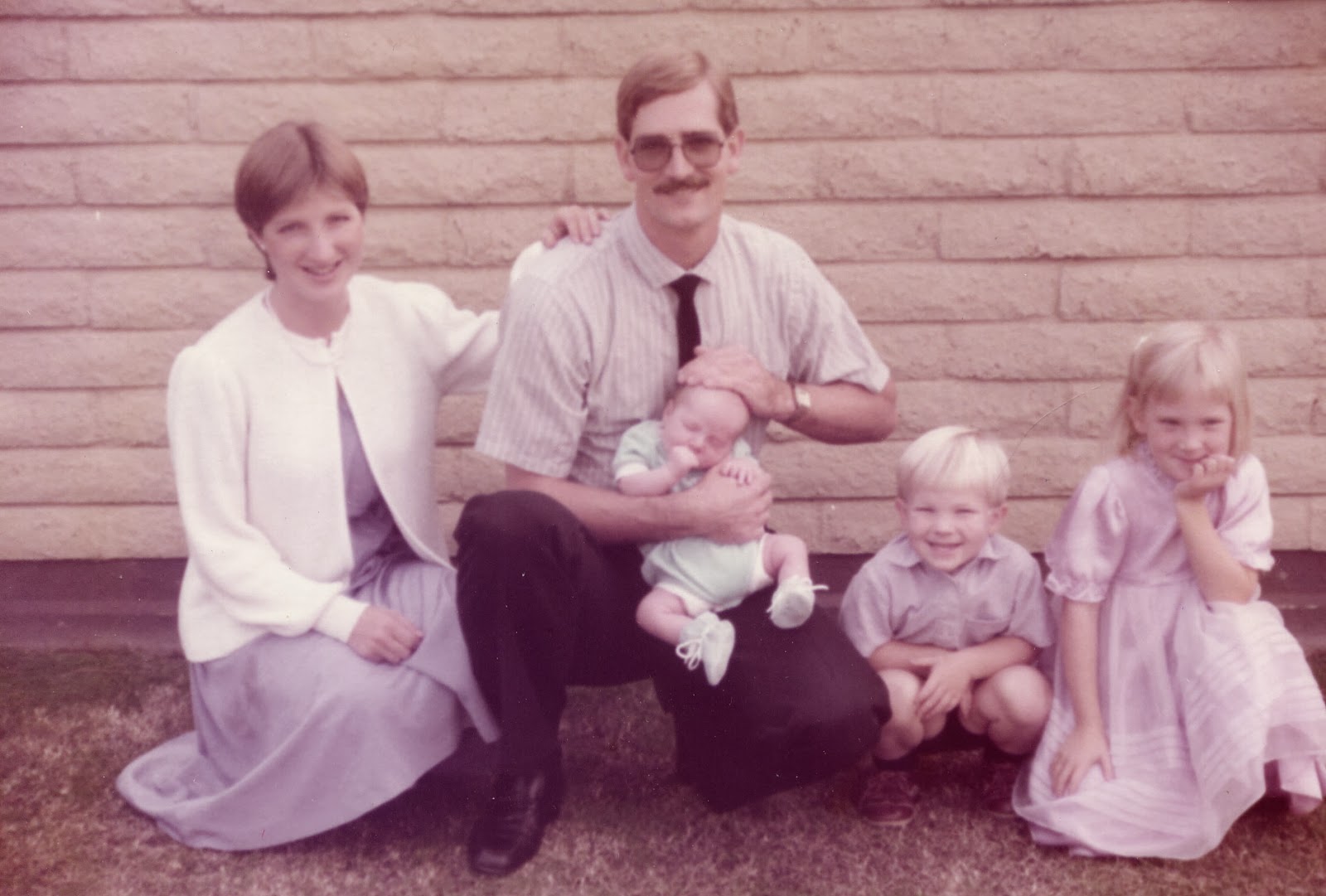
Old Family Photos are the best aren't they!.. circa Late 1984/Early 1985 The Kurt & Paula Van Camp Family (Paula, Kurt, Joshua, Jayson and Bryonny--missing Kyle born in 1987)